The Engine of Imbalance: Why the Universe Refuses to Freeze
When we try to understand the universe, we often picture perfectly balanced, solid building blocks clicking together. However, at the deepest level, reality is not built from solid parts; it is built from pure motion, tension, and a fundamental refusal to balance.
If the universe were in perfect equilibrium, it would be a frozen, silent void. Instead, existence is driven forward by a built-in structural imbalance.
The Geometry of the Proton (The 2:1 Imbalance)
To understand this foundation, imagine a sphere. Inside this sphere, there are three swirling funnels—or "conical occupancies"—taking up the exact same space at the exact same time. They are not stacked on top of each other, nor are they nested like smaller beads inside a larger bead. They run through every single point of the sphere simultaneously.
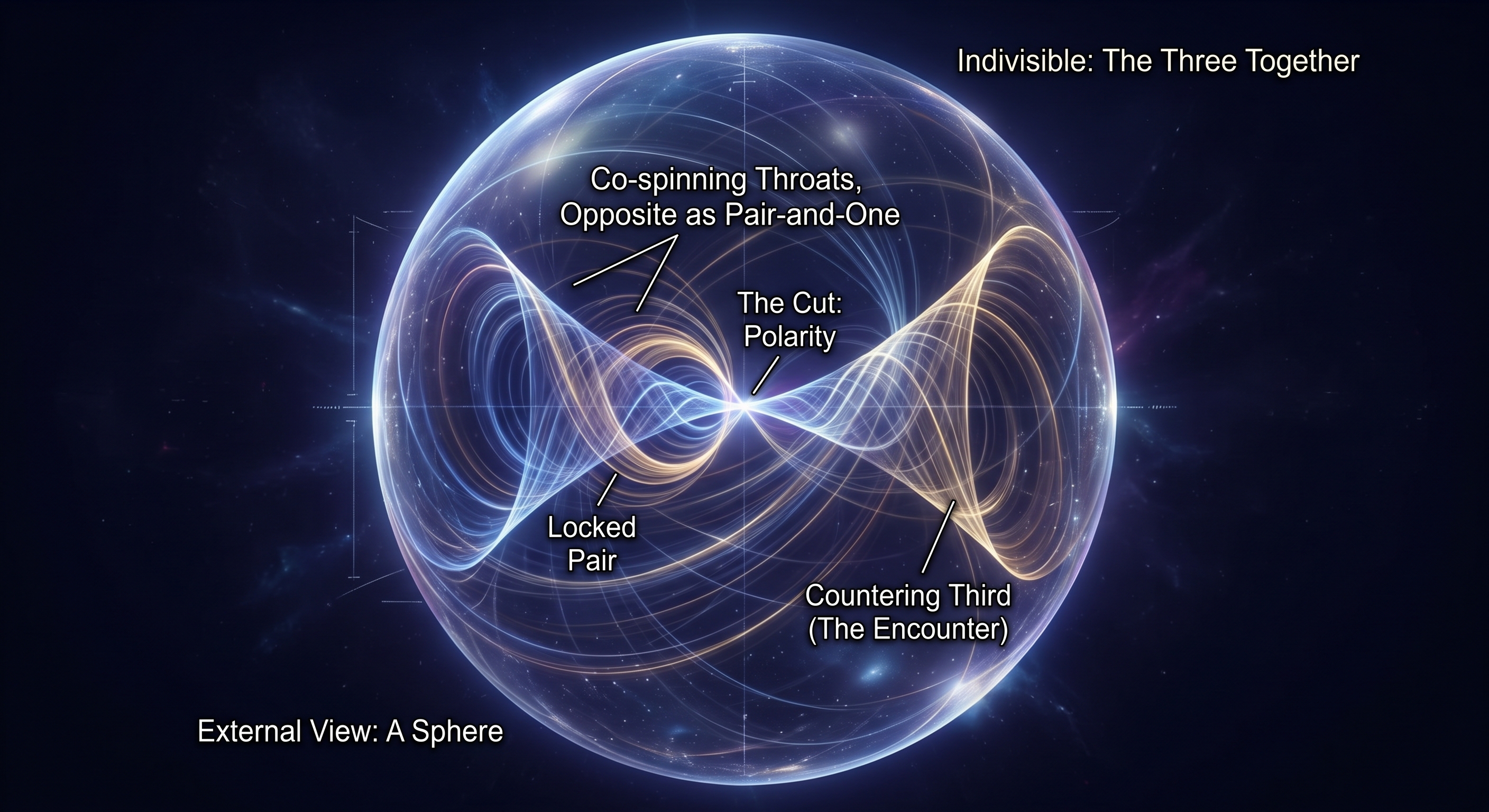
Crucially, these funnels are lopsided: two point toward one end, and one points toward the other. This "2-against-1" facing creates a permanent internal "lean". This uneven cut is what we call polarity.
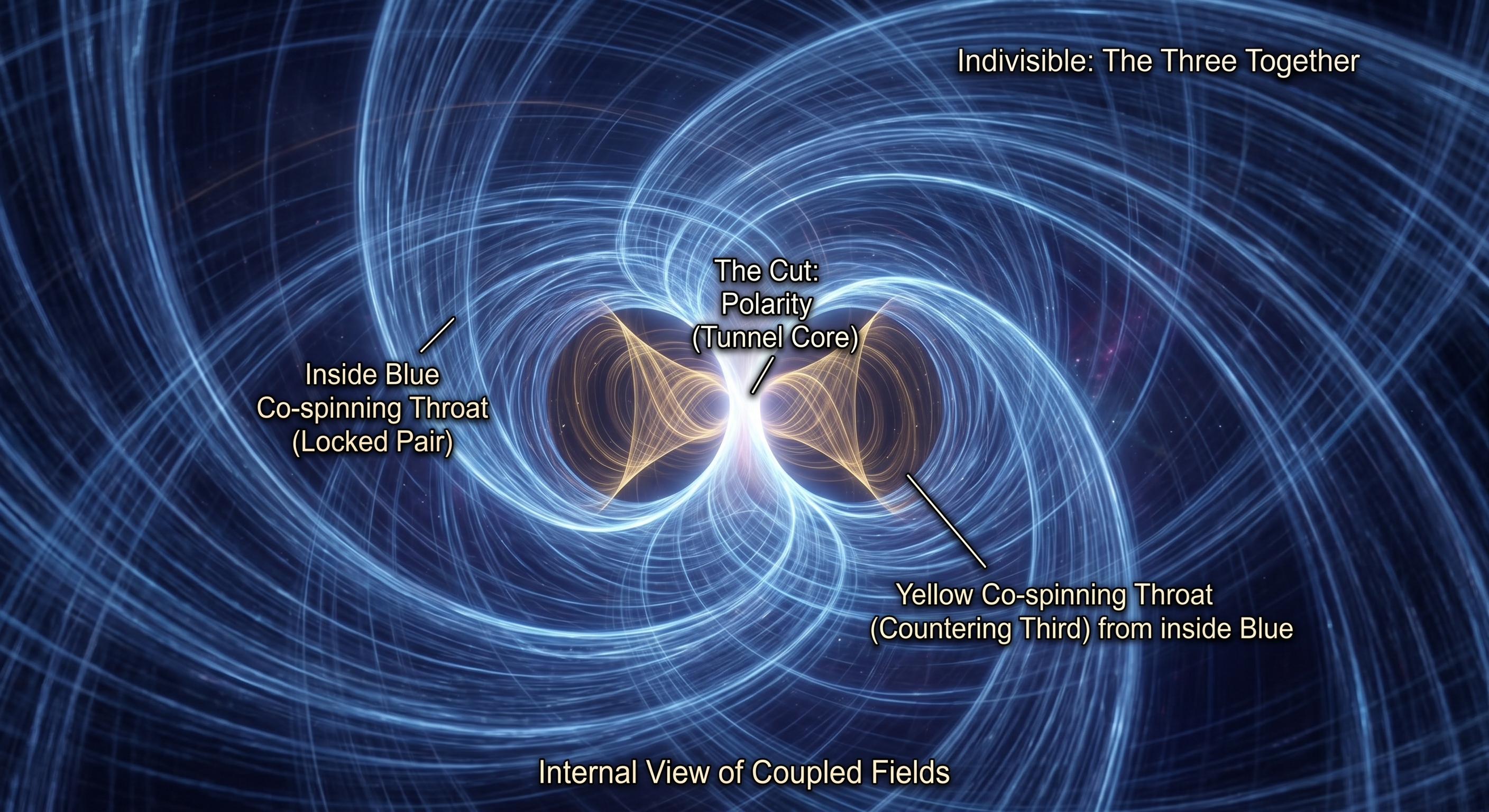
This exact geometry is mirrored in the structure of a proton. A proton is not made of three identical parts; it consists of two "up" quarks and one "down" quark. The up quarks each carry a charge of +⅔, while the down quark carries a charge of −⅓. When you combine them, you get:
+23 + 23 − 13 = +1The proton's positive charge is not painted on from the outside; the charge is the asymmetry. The proton remains stable for billions of years precisely because this 2-to-1 ratio never balances.
The Infinite Gap (Why π Never Closes)
For anything interesting to happen in physics or chemistry, there must be an unresolved gap. Think of an atom as a snake chasing its own tail. If the mouth perfectly caught the tail, the circle would close completely. A perfectly closed system—like a noble gas—has no leftover "lean" and nothing left that needs another atom. If every system achieved this perfect closure, there would be no bonds and no molecules, resulting in chemical death.
Fortunately, the geometry of our universe relies on irrational numbers like π (pi). Because π never resolves into a clean, terminating fraction, the circular path of an orbit can never perfectly close back on itself. There is always a tiny, unbridgeable gap—an "irrational remainder". Because the path cannot close, the system is forced to keep spinning, perpetually trying to finish the loop.
This friction of non-closure is what generates time. If the mathematics of the universe ever perfectly completed and the gap closed, reality would collapse back into a dead, balanced singularity.
The Mathematics of the Encounter (φ2 as the "Plus One")
Because individual atoms have "open shells" and cannot cross that gap to find closure on their own, they crash into other atoms. When they lock together, they generate something entirely new.
This brings us to the mathematical concept of the Golden Ratio, represented by φ (phi). A unique property of this number is the equation:
φ + 1 = φ2When you add "one" to the system, it does not just do simple addition; it jumps to a higher geometric power. In physics, this explains why the whole is exponentially greater than the sum of its parts.
If you measure the mass of a proton, its three quarks account for only about 1% of the total mass. The other 99% comes entirely from the binding energy—the intense force of the interaction holding the quarks together. This massive field of binding energy is the "plus one". It proves that the energy of the encounter completely dwarfs the original parts.
Similarly, complex molecules like NaCl (table salt) or H2O (water) exist because the individual atoms could not finish the job alone. They combine to create a new "plus one" structure built entirely on their shared need to resolve their individual imbalances.
Conclusion
We cannot pull these microscopic systems apart to inspect their individual pieces without destroying the system itself. In physics, this is known as confinement: if you try to pull a quark out of a proton, the immense energy required simply snaps into creating brand new quarks. Confinement is not a cage; it is the structure's ultimate refusal to be decomposed.
The universe relies on these indivisible, unbalanced triads—and the infinite, irrational gaps between them—to keep the engine of reality spinning.