The Physics of Experience: Why Time Flies, Stars Spin, and Life Requires Imbalance
Have you ever wondered why a single summer felt like a lifetime when you were eight years old, but as you get older, the years seem to fly by in a blur?
Most people will tell you this is just a psychological trick of memory. But what if it's not just in your head? What if the way we experience life, aging, and pain is actually governed by the exact same laws of physics that control spinning tops, burning stars, and black holes?
When we look closely at how the universe works, we find that the rules of outer space and the rules of human life are identical. It all comes down to three basic principles: imbalance, direction, and spin.
The Invisible Geometry of Imbalance
Imagine a perfectly balanced seesaw. If both sides weigh exactly the same, the seesaw sits perfectly still. Nothing happens. Perfect balance equals complete silence. For the universe to exist, there has to be a structural imbalance.
To understand how this imbalance works, imagine a sphere. But on the inside, it isn't solid. Instead, imagine three swirling funnels taking up the exact same space at the exact same time. They aren't stacked on top of each other, and they aren't side by side like smaller beads inside a larger one. They run through every single point of that sphere all at once.
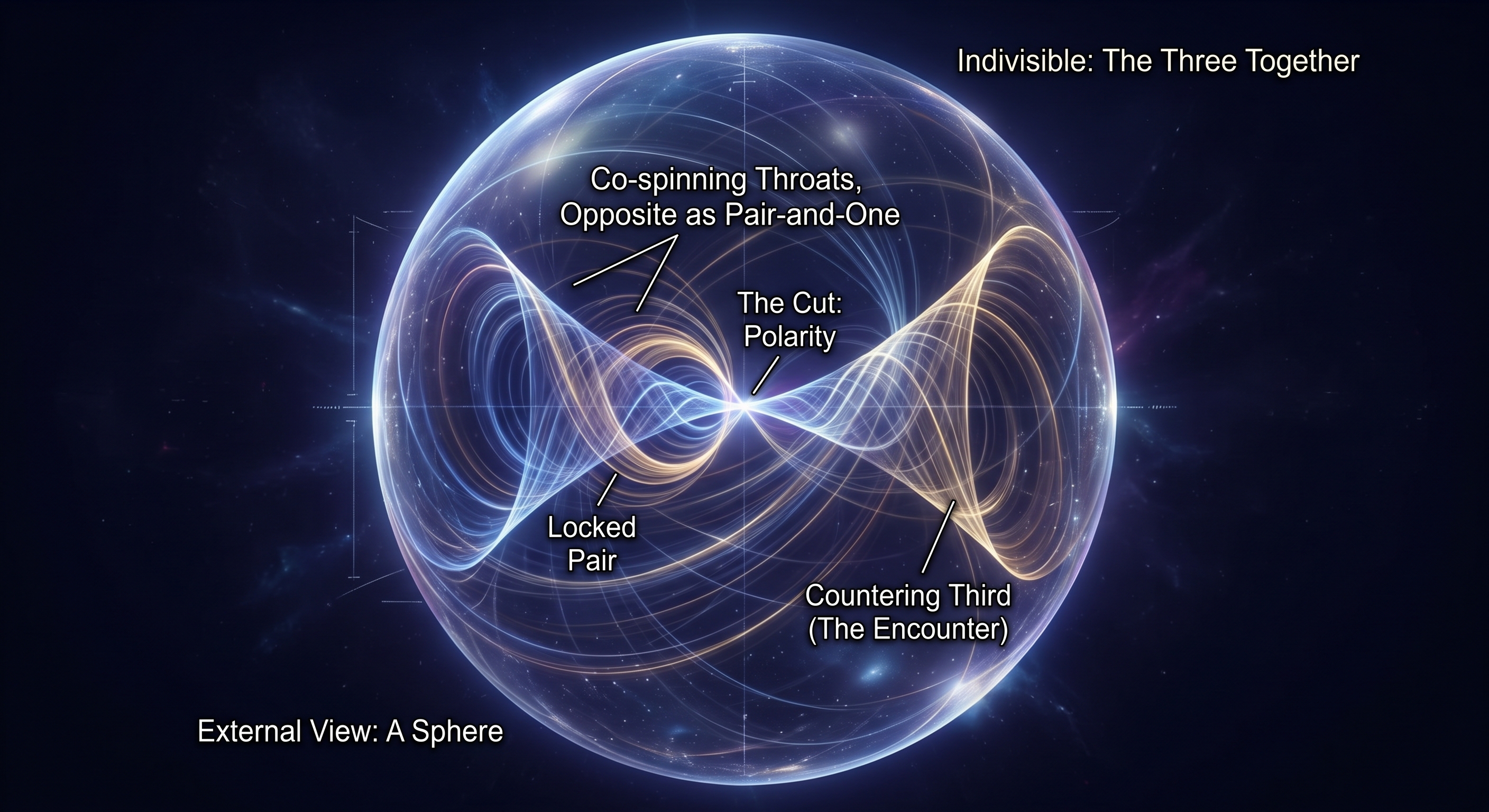
If you were to freeze this motion, you would see that these three funnels form an uneven hourglass: two funnels face toward one end, and one faces the opposite way. Any two can lock together and push against the third. This "two-against-one" tension is the secret engine of reality.
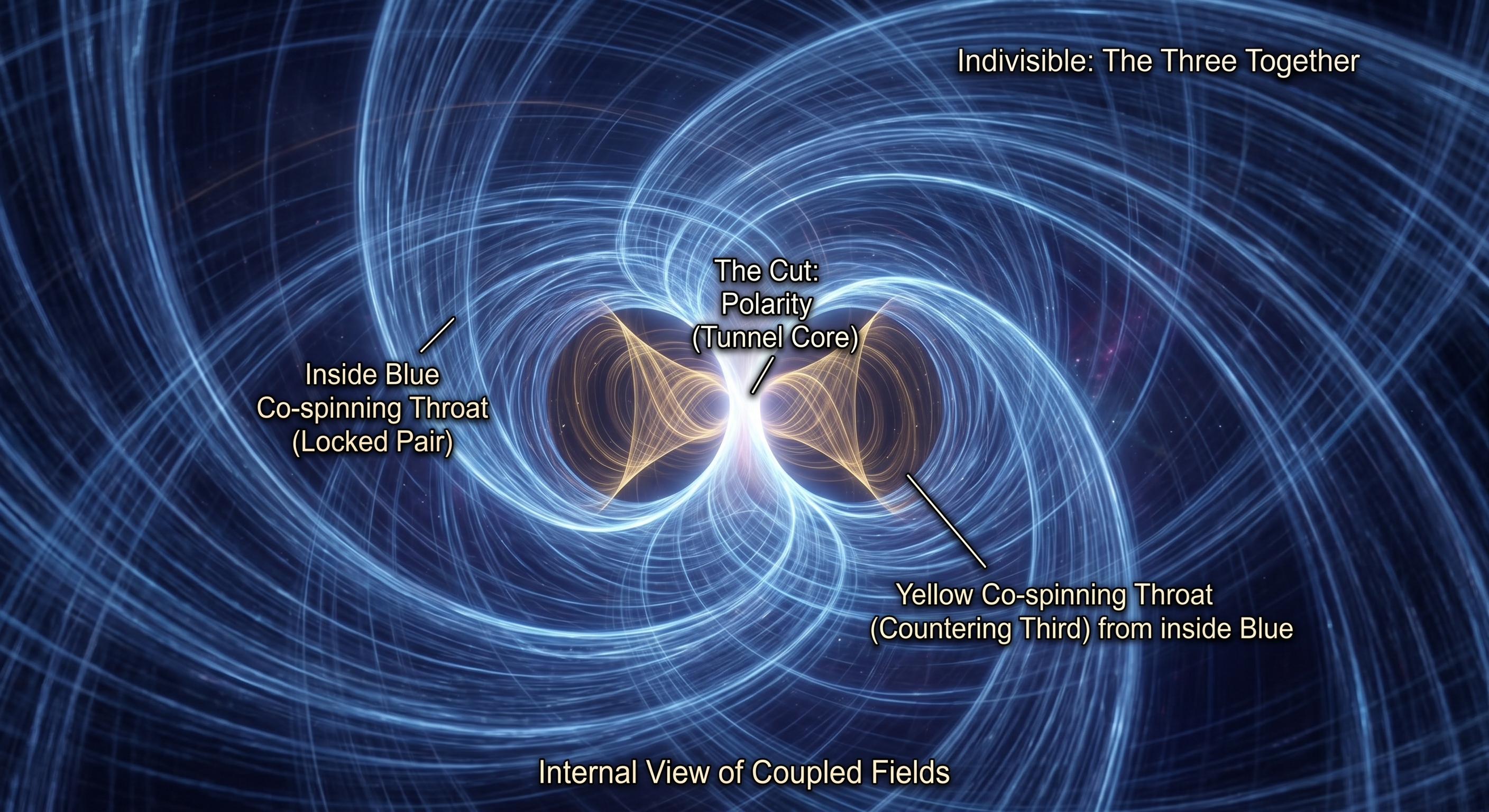
Direction isn't something painted on from the outside afterward. It is baked right into this uneven shape. That built-in lopsidedness creates the poles of a magnet, the spin of a planet, and the drive of a human life.
But here is the catch: you can almost see the pair, but you can only think the third. Sight stops at the things we can comprehend and measure—like our physical bodies and the visible events that happen to us. The third part crosses a line into what a picture cannot hold. It is the invisible, conscious spark holding the tension against the physical world.
If you try to pull one of these pieces out to inspect it on its own, the tension breaks, the spin stops, and the whole system dies. You cannot take life apart to see how it works without ending it. From the outside, we look like solid, whole spheres. But from the inside, we are co-spinning funnels locked in a two-against-one imbalance. We are indivisible because we are the lean of all three parts pulling together, not just a sum of separate pieces.
This specific geometry exists before atoms are formed, before protons are divided into quarks. It is the absolute blueprint of existence.
Gravity is Just a Direction
We usually think of gravity as a heavy, crushing force pulling us toward the ground. But a better way to understand gravity is to simply call it direction.
In empty, blank space, there is no "up," "down," "forward," or "backward." There is nowhere to go. Gravity changes that. It introduces an arrow, born from that two-against-one imbalance. It tells space, "Things need to move this way." Once you have a direction, you have a path. And once you have a path, you can finally experience time, because time only exists when you are moving toward something.
The Gyroscope of Life
So, what happens when you take the built-in imbalance of life and combine it with the direction of gravity? You get a gyroscope.
Think of a spinning top. If you place a top on a table without spinning it, gravity pulls it straight down, and it instantly falls over. But if you give the top a fast spin, it stands straight up, defying gravity.
Human life works exactly the same way. Every day, you take in new experiences, learn new things, and make choices. All of those experiences create a "spin."
But life is full of friction. You fail a test, lose a friend, or get hurt. When a hard event hits you, it is like flicking the side of that spinning top. The top doesn't fall over right away, but it wobbles. That violent wobble is what we experience as pain or stress. Your mind and body have been knocked off balance.
"Healing" is simply the process of taking the time to let the top restabilize. As the wobble slows down and you find your center again, the event leaves a physical or mental mark—a scar. But that scar isn't a bad thing; it is the permanent, structural proof that you gained new knowledge and survived the friction.
Why Time Flies as We Age
This gyroscopic spin perfectly explains why time speeds up as we get older.
When you are young, you haven't accumulated many experiences yet. Your spinning top is very light. Because it is light, it spins relatively slowly. Without much speed, your internal sense of time is stretched out and relaxed.
But as you age, you collect decades of memories, scars, skills, and relationships. All of those experiences add physical and mental "weight" to your life. In order to keep a much heavier top from falling over, the engine of your mind has to spin it faster and faster.
Albert Einstein taught us that as velocity increases, time compresses. Because an older person's mind is spinning an incredibly heavy load of life experiences at a massive speed, their internal clock literally compresses. To them, the outside world seems to be moving on fast-forward. They aren't imagining it. Their internal physics have changed.
The Ultimate Limit: Stars and Black Holes
If we keep adding weight and speed, what happens at the very end of the journey? We can look at the stars for the answer.
A star, like our Sun, is essentially a giant spinning top made of gas. It creates massive friction at its core, which produces light and pushes outward to keep the star from collapsing under its own heavy gravity. But eventually, a star runs out of fuel. The friction stops. Without that outward push, gravity takes over, and the physical body of the star collapses.
If the star was heavy enough, it collapses into a black hole. A black hole is not an empty drain in space. It is the heaviest, most experienced object in the universe. It has taken in so much matter, and it spins so incredibly fast, that time at its edge effectively stops. It became so heavy that its physical hardware shattered, leaving behind pure gravity and compressed time.
Human life reaches a similar threshold. The human body is a temporary physical shell meant to hold our spinning experiences. Eventually, we gather so much weight, so many memories, and so much compressed time that our biological hardware simply cannot contain the velocity anymore. The body gives out, the two-against-one lock finally releases, and the energy of a lifetime of experiences drops back into the universe.
Conclusion
We are not separate from the universe; we are miniature models of it. The next time you face a difficult challenge, remember that the friction you feel isn't a mistake. It is the exact same force that makes the stars burn. Your struggles are the energy that keeps you spinning, keeps you standing upright, and drives you forward through the incredible, spinning journey of existence.