The Physics of the Encounter: The Indivisible Triad from Quarks to Quasars
You cannot find a breath by dissecting a lung, but you can measure the heat it generates as it breathes. For centuries, science has built brilliant instruments to measure reality—from fMRI machines tracking blood oxygenation to atomic clocks measuring decay. However, these tools measure the exhaust (the heat, the friction) rather than the engine itself.
By shifting our lens from static, solid building blocks to dynamic, relational geometry, we can articulate a unified vision of the universe. This architecture—the Indivisible Triad—scales flawlessly from the core of an atom to the event horizon of a black hole.
The Fundamental Geometry: The 2:1 Imbalance
At the foundation of reality, there are no solid, isolated beads. Instead, imagine a sphere containing three "co-spinning throats" or conical occupancies that run through every point of the volume simultaneously. They are not nested or stacked; they are the same space leaning three ways at once.
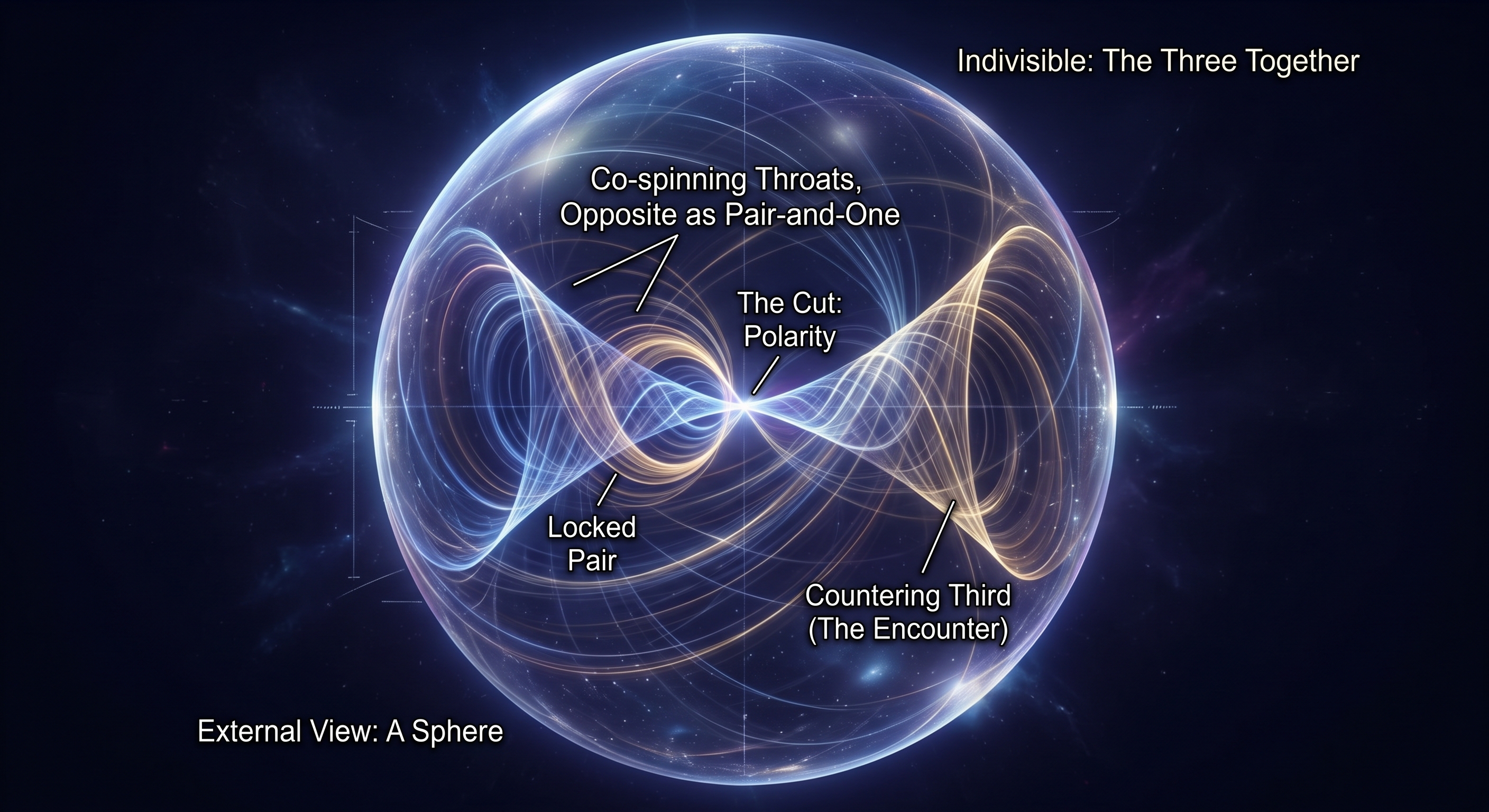
Crucially, this geometry is unbalanced: two cones face one direction, and one faces the other. This "2-against-1" facing creates a permanent structural imbalance, and this lean is the polarity of the system.
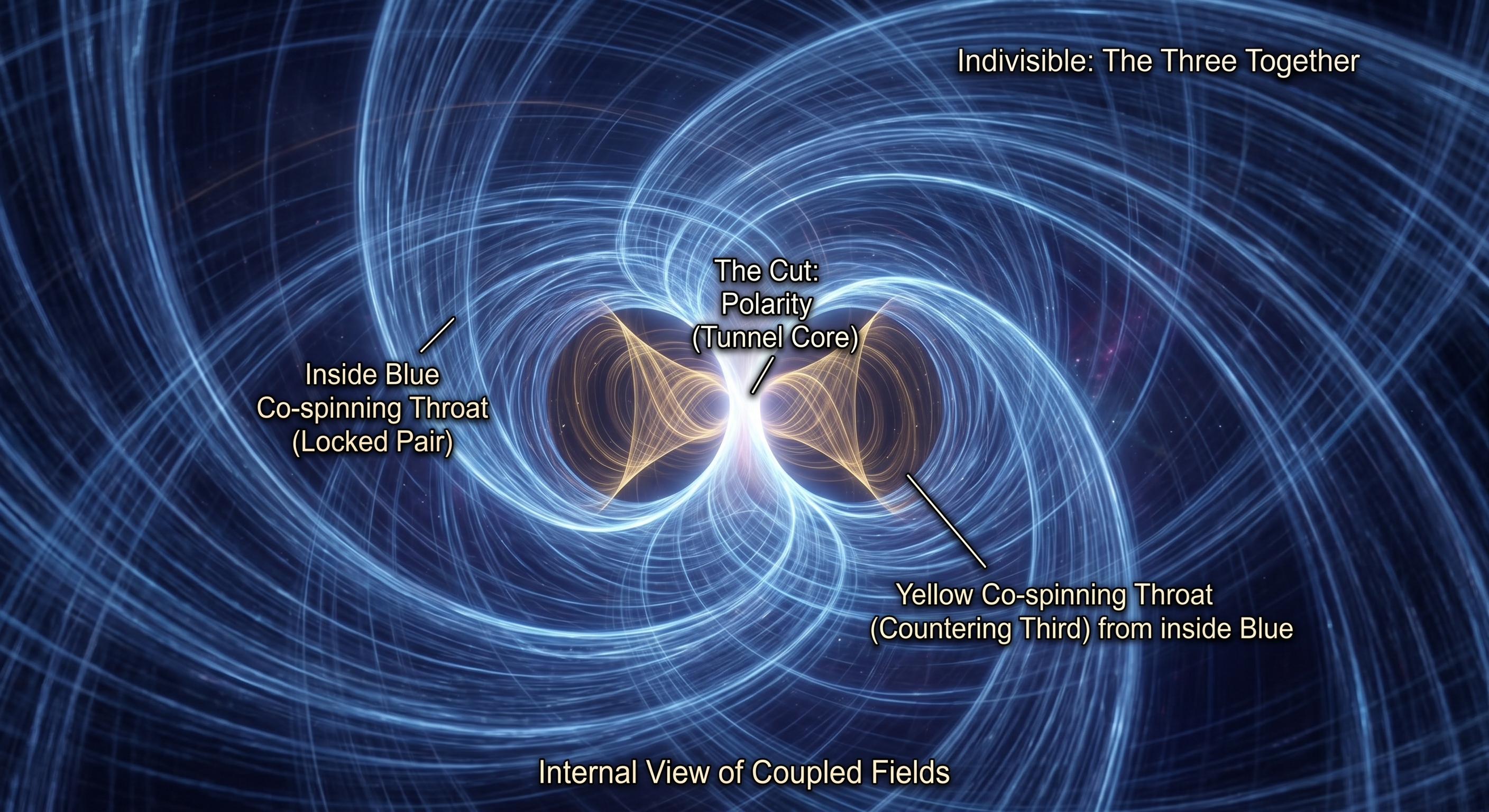
We see this exact blueprint inside the proton. A proton is not a collection of three identical parts; it consists of two "up" quarks and one "down" quark. The up quarks carry a fractional charge of +⅔, while the down quark carries −⅓. The math perfectly reflects the 2-against-1 lean:
+23 + 23 − 13 = +1The positive charge of a proton is not painted on afterward; the charge is the asymmetry itself.
Furthermore, you cannot pull this triad apart. In quantum chromodynamics, this is known as confinement. If you inject enough energy to separate a quark, the structure refuses to be decomposed; the energy itself simply generates new quarks. The breaking of the system is its replication.
When physics measures the mass of a proton, the actual quarks account for only about 1% of the mass. The remaining 99% is binding energy—the intense field generated by their interaction. The whole is exponentially greater than the sum of its parts, following the mathematical logic of the golden ratio, φ (phi):
φ + 1 = φ2The encounter dwarfs the substrate, creating a massive "plus one".
The Engine of Time: The Friction of Non-Closure
For a system to remain active, its internal path must never perfectly close. If the "mouth" of the system perfectly catches its "tail", the circle closes, the gradient flattens, and the system dies. For example, the element Neon has a rational winding ratio of exactly 2; its path closes perfectly, resulting in the isometric freedom and inert silence of the void.
Active systems survive because they rely on an "irrational remainder"—such as π or φ—that forces the path to perpetually miss closing by a tiny fraction. Because the path never resolves, the system must keep spinning.
This physical refusal to resolve generates what we experience as time. Time is the friction of non-closure.
We can map this thermodynamically. The rate of time passing is equal to the rate of energy dissipated to sustain this non-closing path against equilibrium:
S•occ = 1T (dQdt)occupancy If the path ever fully closes, the rate drops to zero, and time ceases locally.The Macro Scale: Gravity, Dark Energy, and Black Holes
This exact tripartite architecture (Direction, Constraint, and Experience) scales up to the cosmos.
Gravity and Dark Energy
Gravity is not a pulling force; it is the establishment of direction itself. Think of centrifugal force on a merry-go-round: the object has an intrinsic direction (straight-line motion), and the physical ride is the constraint that curves it. The felt outward push is simply the friction between your intrinsic direction and the constraint. Gravity provides the universal orientation for this interaction.
Conversely, Dark Energy is the inverse of this mechanism. If gravity is the establishment of a "lean" or direction, Dark Energy is the dissolution of that lean—an isotropic expansion back into the pathless void where all direction is lost.
Planets, Stars, and Galaxies
Jupiter: Operates as a molecular-scale enzyme, a massive spinning system that gives more than it takes, spinning for billions of cycles without losing its geometric shape.
The Sun: A star is a toroidal field confined inside a spherical boundary. Its internal winding constantly misses closure, and the violent friction of that near-miss (nuclear fusion) sustains the entire architecture. Galaxies are simply this same 2-against-1 polarity scaled up to structural communities.
Black Holes: A black hole represents the terminal limit of the equation. At the event horizon, the massive gravity means the direction is fully resolved, and the path is finally forced to close. Because the path closes, the friction drops to zero, and time mathematically stops.
From the fractional charge of a quark to the freezing of time at a singularity, the universe is not a collection of objects. It is a single, indivisible triad, endlessly spinning through the friction of its own non-closure.